- More
- Back
Embarking on the task of selecting my favourite works by Agatha Christie – a writer whose plays, books and short stories have captivated me since my childhood – has been a journey filled with both nostalgia and admiration.
I still vividly recall the first time I visited her world, a world so intricately woven with mystery and suspense that it leaves an indelible mark on the reader.
Was it a challenge to whittle down her extensive output to a mere 10 books? Unquestionably so. Given the opportunity, I would eagerly list 20 titles and still feel the pang of leaving out several beloved works. Each book by Christie is a masterclass in storytelling, her craft so refined that choosing favourites seems a disservice to her genius.
I first read Christie as a boy, and I read her again last month. She is the writer I recommend to anyone who thinks they don’t like mystery novels — because nobody can read And Then There Were None and not feel that small, delicious shock of being outwitted.
Here, in order, are the ten I’d take to the desert island.
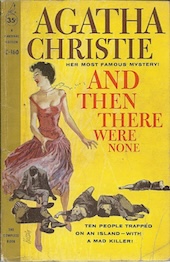
1. AND THEN THERE WERE NONE (1939)
Her masterpiece.
This is at number one because I honestly think it’s the best thing she ever did. There were rumours that Christie’s plot was influenced by other works at the time, not to mention her own book, The Murder of Roger Ackroyd.
Ten strangers are summoned to an island off the Devon coast. They cannot leave — the boat does not come back. One by one, they are killed, in the order of an old nursery rhyme, and each of them, it turns out, is guilty of something. You’re all stuck there because you’re all evil people. And you’re going to be killed off one by one because you’re all evil people.
Christie took the central idea from a translation of a German novel, and has been perfectly open about it. I find it hard to believe the original was in the same class. She rewrote it, tightened it, and produced the most perfect closed-circle thriller ever written. It is the book other crime writers — Knives Out, Glass Onion, every country-house homage — keep trying to match. None of them quite does. I shall not tell you how it ends. That would be criminal.

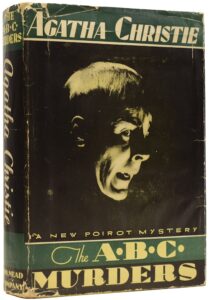
The David Suchet version on TV was excellent. It’s such a clever idea, and yet such a simple one, which is what Christie was always so good at. Going through the alphabet, with each murder corresponding to the next letter. This being Christie, things are not so simple: a little misdirection here and there, a (not so) obvious culprit, a clever bluff from Poirot.
I first read this book when I was 16 or 17 and I was astounded by how good it was. Here we are, more than 60 years later, and it’s lost none of its power. Or its mystery!

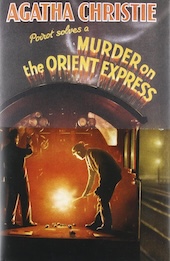
Because of the big screen adaptations – the 1974 version directed by Sidney Lumet and starring Albert Finney as Poirot was a huge success and picked up a whole heap of Oscar and BAFTA nominations – it has become Christie’s best-known work. I. After you’ve seen David Suchet, it’s hard to watch anyone else.
A train. A dead man. Twelve suspects. Snow stops the carriage. Poirot is on board. You know the setup — everyone does.
What you may have forgotten is the mechanism. Every one of them stabs him, and Poirot works out, because of the wounds, that it couldn’t have been one person. That single detail — a pathologist’s observation turned into a plot — is what makes the book great. She does not cheat. The wounds give the game away to Poirot before they give it away to us, and when he explains it, we realise the whole novel has been hiding in plain sight.
It has been filmed a dozen times and will be filmed a dozen more. Read the book first. The pages are cleverer than any film.

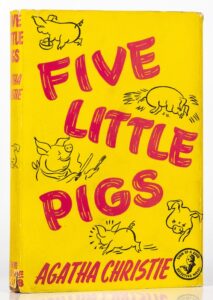
This is Christie at her most audacious. The murder has already happened. The murderer has already been convicted and died in prison. The case is sixteen years old and closed. And then Poirot is hired by the victim’s daughter to prove her mother was innocent.
What Christie does next is extraordinary. She gives us the same story five times, told by five different witnesses, each of them a suspect, each of them lying about something. The reader has to work out not only who did it but who is telling the truth about what, and when. No running about, no fresh corpses, no last-minute revelations in the library. Just five people remembering — or misremembering — a summer’s day in 1926.
I shall not tell you who did it. I shall say only that the ending is among the most emotionally devastating in Christie, and that when you close the book you will want to read the first chapter again. Almost everything was in plain sight all along.

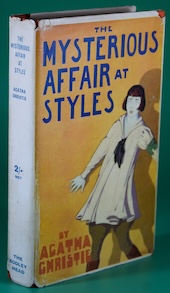
Almost impossible to believe this with Christie’s firs published novel and her first ‘detective’ novel and, as such, is the first time we meet this Belgian chap, Hercule Poirot – probably now the #1 detective in literary history.
Christie’s debut — the novel that introduced Poirot. Captain Hastings narrates; Emily Inglethorpe is poisoned; and every subsequent detective novel Christie wrote has a piece of Styles in its DNA.
It is a good book. Not her masterpiece, and I don’t think she would claim it was. But for a first novel — a first detective novel, at that — the architecture is already in place: the country house, the isolated suspects, the little Belgian with the moustache who notices what nobody else has noticed.
There is a lot of crime writing out there. A lot of excellent books and a lot of average books. Every now and then, we hear about a best-seller who is supposed to be the new Agatha Christie.
Let’s be perfectly honest here… there’s never been a ‘new Agatha Christie’ and I doubt if there ever will be.
If you want to read her in order, start here. If you want to read her at her peak, skip ahead to Roger Ackroyd or And Then There Were None.

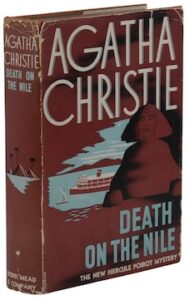
Christie takes us to Egypt, and wow, what a setting! It’s a love story gone wrong and chock-full of surprises. I love how she keeps us in the dark while allowing Poirot to sort out the mess. Although this has all the ingredients of a classic Christie adventure, it proves that they work just as well in the Sahara as they do in Stourton Heath.

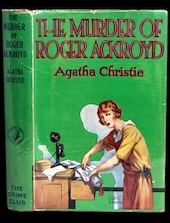
A book that blew my mind! Christie was so daring with this one and the ending really is something else – it turns the whole book upside down. For some people, it’s regarded as Christie’s masterpiece and it’s difficult to argue with them. It was a game-changer in crime fiction.
The book that broke a rule, and in breaking it, made Christie immortal.
The genius of Roger Ackroyd is that the man who’s telling you the story is the criminal. It is the most daring narrative trick in the history of the detective novel, and it caused fury at the time — readers accused her of cheating. She had not cheated. Every clue is on the page. You simply trust your narrator, which is what any sane reader does, and that trust is the con she is running on you.
Go back and read the opening pages after you have finished. The misdirection is so elegant, so quiet, that you will want to applaud her. I did.
If you’ve never read any Christie, this is the perfect place to make a start. You won’t be disappointed.
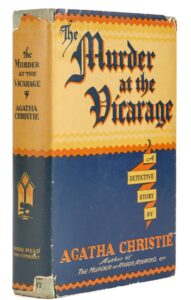
8. THE MURDER AT THE VICARAGE (1930)Here we meet Miss Marple, and it turns out that she’s just as cool as Poirot. The story is set in a quaint English village, and – as you’d expect – it’s filled with gossip and secrets. Miss Marple is sharp and sees things others miss. Christie really nailed it with this character and the archetypal Arcadian setting.

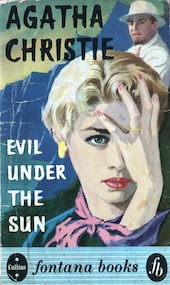
Evil Under the Sun is fantastic. Set in a holiday resort – the 1982 film with Peter Ustinov was filmed in Majorca, the 2001 TV version with David Suchet was filmed in South Devon – the story is overflowing with twists, turns and shady characters. Christie is an expert at keeping us off track, allowing Poirot, as usual, to figure it all out in his unique way. A reminder of how good she was at surprising her readers.

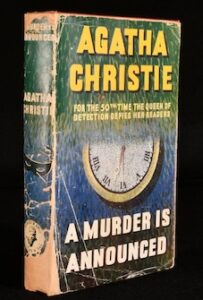
What a startling way to open a crime novel: a murder announced in the newspaper! The suspense in this book is top-notch. Miss Marple has to be at her best because every character and clue matters. It’s one of those Christie books that shows why she was absolutely unbeatable when it came to mystery writing.
I couldn’t have written my William Warwick Detective series without Christie.
She taught me that a good mystery is a puzzle first and a novel second. My William Warwick Series starts with Nothing Ventured – a young CID officer, a stolen Rembrandt, and the case that made his career.
Read Chapter 1 of Nothing Ventured (WW1)
See all William Warwick books
More Unputdownable lists
Top 14 Best Murder Mystery Novels and Books
Top 12 Best Classic Novels of All Time
Join my community
I send occasional personal letters to readers about the books I’m reading, what I’m writing, and what’s coming next. No spam, just notes from me. Please sign up below if interested to hear more.